Companies and organizations are forced to adapt their working environment to the technological and process-related framework conditions and to motivate employees in order to increase productivity and find skilled workers. Frey und Frey accompanies you from decision-making through planning and implementation to the goal.
"The office" has undergone an incredible transformation in just a few years and presents employers with interesting prospects. Several factors intertwine on multiple levels. Fortunately synergistically - the modern working environment and interior design combine economic optimization, technology integration and the well-being and motivation of employees.
THE NEW FRAMEWORK CONDITIONS FOR MODERN OFFICE ARCHITECTURE
Two main aspects of the change in the spatial conception of dynamic companies must be emphasized: The two Corona years and the increasing shortage of skilled workers. Both have set a challenging change management process in motion, or in other words, they have become the drivers for new forms of work and new worlds in line with the technological possibilities available today.
THE CORONA DICTATE
Offices had to close virtually from one day to the next and the workplace was moved to the home. Decades ago, this was pejoratively referred to as working from home, but now it's called working from home. Although the "quarantine" measures of the pandemic are now history and many employees have returned to the office, working from home is here to stay, at least in part-time positions. The consequences for employees are a more flexible working day, partial elimination of commuting and thus more free time. The consequences for companies are the reorganization of teamwork, the workflow and often a lower need for space, which reduces costs.
THE SHORTAGE OF SKILLED WORKERS
HR managers in almost all sectors are desperately looking for suitable employees - the labor market has dried up. To make matters worse, skilled workers between the ages of 20 and 45 attach just as much importance to work-life balance and attractive employment conditions as they do to remuneration. This means that workloads are tending to decrease, topics such as the 4-day week are becoming more topical and attractive and there is the option of working from home.
Employees' expectations are rising - the employer's image and working environment are becoming key criteria when looking for a job.
"Which company stands for innovation and offers me an attractive and modern working environment?" Accordingly, new concepts of workspaces are emerging for personnel recruitment.
THE SUM OF THE ADVANTAGES OF MODERN OFFICE ENVIRONMENTS
- High spatial flexibility, space savings
- Greater sense of togetherness, work motivation and creative stimulation, promotion of company culture
- More internal networking, more holistic coordination and cooperation
- Mobile working
- Barrier-free integration of all digital technologies in the office and home office
- Sustainable human resource management
- Different, flexible work zones to suit the activities
- Optimized workflow for more innovative strength
- More cost and energy efficiency
WHAT EXACTLY IS NEW?
It will not be the case that the office concepts of tomorrow and the day after tomorrow will cause all 'old' office forms to disappear: In the future, there will still be open-plan offices, group offices or - where confidentiality and privacy are essential - individual offices. The office will remain the hub of corporate culture.
However, the new spatial concepts with modularity, mobility, multifunctionality, ergonomics at the workplace, transparency, an adapted infrastructure and flexibility will contribute to a new and inspiring working environment. Keywords here are free choice of space, desk sharing, coworking areas and focus zones. The different areas provide attractive workplaces with the additional benefit of group work for smaller, situational teams. This results in greater working comfort, more dynamic workflows and increased productivity.
Another key image factor is that innovatively designed working environments make the contemporary corporate culture and the company's readiness for the future visible and tangible for employees and company guests.
THE 8 STAGES TO THE NEW WORLD OF WORK
The consulting teams, interior designers and architects at Frey & Frey support you from strategy development to implementation. Right from the initial phase, our principle for success is close and trusting cooperation.
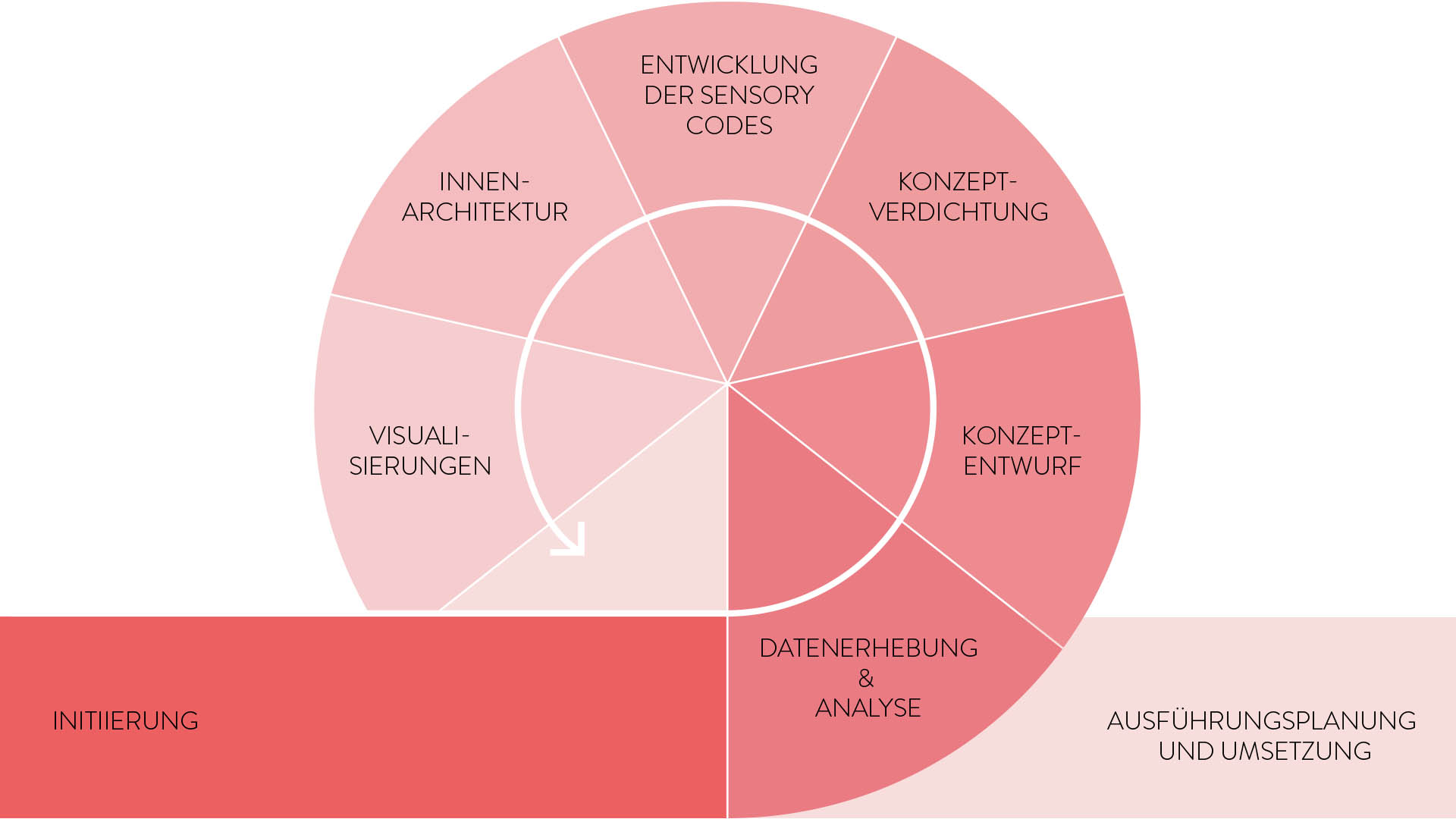
PHASE 1: INITIALIZATION
In the first stage, the framework conditions for the target project must be defined. This includes the project organization (roles, responsibilities) as well as an assessment of the operational benefits, opportunities and risks, the budget and deadlines.
PHASE 2: DATA COLLECTION AND ANALYSIS
In the second stage, all planning-relevant parameters are recorded, such as the number of workstations, the shared desk ratio, the network of relationships between departments and teams and the internal process structures. The company DNA is also recorded and included in the analysis.
PHASE 3: CONCEPT DESIGN
With the data now analyzed and evaluated, the conception begins, i.e. a concretization and translation of the needs into an initial floor plan and occupancy model.
PHASE 4: CONCEPT CONSOLIDATION
This phase represents the realization test of the space requirements and the networking of all areas of activity (detailed analysis of practicality). The result of the concept consolidation forms the starting point for the development of the interior design. Initial clarifications are made regarding feasibility and any building permits.
PHASE 5: DEVELOPMENT OF THE SENSORY CODES
Stage 5 is dedicated to corporate identity and appearance. Colors, textures, materialization and form and design language define the visual style.
PHASE 6: INTERIOR DESIGN
In this step, the holistic interior design concept is developed on the basis of the sensory codes. Topics such as lighting, acoustics, furniture, floor and wall coverings etc. are worked out and specified.
PHASE 7: VISUALIZATIONS
The interior design concept that has now been developed is being visually concretized. 3D visualizations of the various areas will be created, inviting you to immerse yourself in the new working environment.
PHASE 8: IMPLEMENTATION PLANNING AND REALIZATION
The implementation of the project is ensured. Objectives are defined, costs are calculated and a detailed project plan is drawn up. Where necessary, appropriate building permits are obtained. The project is now implemented with the planned measures until it is handed over to the customer.
SHORT AND SWEET:
Open office concepts, communal areas - even fitness rooms and retreats are options - and the integration of new technologies for collaboration are the new norm. It combines work and life: The new way of working in innovative workspaces focuses on the needs and well-being of employees, on optimized collaboration and networking. The new world of work is a stimulating and exciting place to be, a motivating response to the expectations of a better work-life balance.
The resulting increase in employee creativity, agility and productivity also boosts the company's competitiveness.